
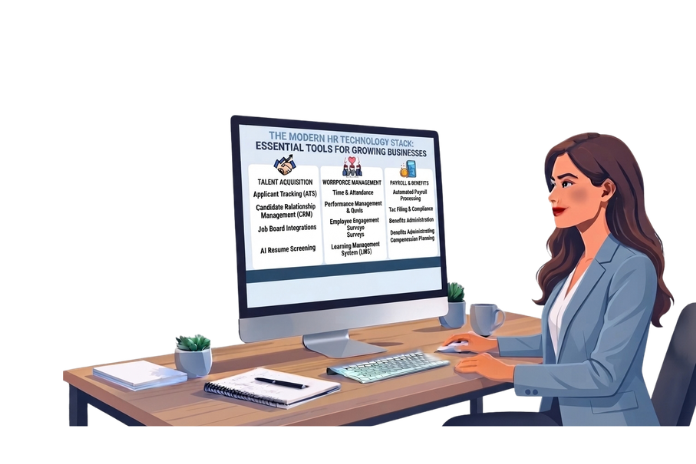
The process of managing employees becomes difficult as the size of the business expands. Dealing with the process of hiring new employees, collecting data on their work and personal lives, calculating payroll, tracking their performance, managing benefits, and engaging them becomes a difficult process that becomes tough to carry out through the traditional processes of doing it.
Having an HR technology stack helps the business in overcoming the challenges posed through connecting the required HR tools in one digital environment. There are several kinds of HR technology stacks, including core HR, recruiting, payroll, engagement, performance, and workforce analytics tools, among others.
For growing businesses, the construction of an HR technology stack requires more than just using software tools.
What Is an HR Technology Stack?
An HR technology stack is defined as a bundle of technology-based tools used by organizations to perform different phases of the employee lifecycle process. Organizations do not need to use one single application for performing HR tasks, but they can use many software applications depending on the requirement.
Examples of HR technology stack may include:
- Core HR software
- Applicant Tracking System
- Payroll software
- On-boarding software for the employees
- Time & attendance software
- Performance management software
- Learning management systems
- Employee engagement software
- Benefits administration software
- Workforce analytics software
The software can either be independent or integrated.
Why Growing Businesses Need HR Technology
With growth in organizational size, there is usually an increase in the number of employees working under the HR department even when there aren’t enough administrative sources. These problems include wasting time, repetition of work, mistakes, and burdening of the administration.
Useful HR software for organizations growing in size.
Reducing Administrative Work
HR staff must devote a good amount of time to such recurring tasks as updating information of employees, leaving management, documentation, and report generation.
These recurring tasks can be automated by simply implementing some predefined workflows that will help HR staff to utilize their time in other important functions such as work force planning and development of employees.
Creating a Centralized Employee Data Hub
It is difficult to control the data related to employees which are scattered among many spreadsheets and systems. There would be one point from where all the information about the company’s employees could be accessed by using HR software applications.
All the necessary data regarding employee profile, job positions, organizational structure, attendance, etc., would be accessible through HR software application.
Core HR Software as the Foundation
The core HR software frequently acts as the foundation of HR technology solutions. The software offers a framework that enables management of information and HR processes.
Some functionalities of core HR systems include HR processes like employee data maintenance, organizational charts, documents, time off, workflows, and reporting.
As regards growing companies, scalability becomes an issue. This feature allows the system to deal with new employees, offices, departments, and HR processes.
Recruitment and Applicant Tracking Tools
Recruitment is an essential part of business growth but can be very difficult and time-consuming if performed manually through applications, communications with applicants, arranging interviews, and taking decisions.
That is where the applicant tracking system steps in.
Streamlining the Hiring Process
Recruitment software assists HR teams in listing job openings, receiving resumes, managing candidate profiles, conducting interviews, and managing candidates throughout the recruitment process.
The automated communication process will help save time and provide better experience for the candidates.
Supporting Better Hiring Workflows
These recruitment statistics would be useful for organizations in monitoring their recruitment processes, including the number of people who join the recruitment process, time taken to complete each step of the recruitment process, and sources of recruitment.
Payroll and Benefits Management
A payroll is made complex if there is an increase in numbers within the payroll department, in the number of sites and in salaries and benefits of the organization.
This payroll system can automate the procedure of calculating salary, deductions, taxes, and payroll reports depending on how good the software is and requirements from the local law.
Benefits administration software is more competent than the payroll software in managing information about benefits packages.
Employee Onboarding Technology
The new employees are provided with knowledge about their duties at work, accomplish the required paperwork, and have knowledge of the policies and procedures of the organization through onboarding.
This can be achieved using technology in the onboarding process.
Creating Automated Onboarding Workflows
The HR department can design checklists, where responsibilities will be allocated to employees, managers, IT experts, and others who take part in this process.
For example, new recruits will carry out tasks such as filling out the forms, uploading documents, familiarizing themselves with the company policies, gaining access to the training materials, and managing their onboarding process in one system.
It will make the whole process more organized.
Performance Management Platforms
In addition to conventional yearly performance reviews, there is a growing trend towards continuous performance management.
Performance management software may prove useful in setting objectives and assessing the development of employees.
Connecting Goals with Business Objectives
The use of performance management approaches will assist managers in defining goals for their subordinates and teams, which will be consistent with organizational goals.
Performance management will give an insight into the needs of training and coaching of employees.
Learning and Development Tools
Employee Development as an Issue Has Gained Even More Significance with Regards to Competency Development in Organizations and Retention of Key Employees.
As an example, a learning management system might give employees the opportunity to participate in training programs, educational materials, certification, and development programs.
By utilizing learning technologies, it is possible to arrange training programs for new hires, managers, technical staff, and others.
Learning analytics might also allow the HR departments to measure how engaged employees are and what type of training is required.
Employee Engagement and Communication Tools
Solutions for improving employee engagement enable firms to collect data and communicate with their employees.
This large umbrella term covers various aspects including surveys, programs of rewarding employees, channels for collecting feedback, and even internal communication.
Understanding the Employee Experience
Feedback is an instrument that could help an organization understand how their employees feel about their organizational culture, communications, and engagement.
The human resource team can use this trend analysis to take necessary action.
Time, Attendance, and Workforce Management
The attendance and time management software will assist the firm in managing the hours worked, work schedule, overtime, absence, and leave management in the organization.
In case there are workers who work in shifts or remotely in the organization, the use of attendance management software will enable the organization to gain more insight into the availability of the workers.
The integration of attendance information with the payroll and HR management systems will minimize manual entries.
HR Analytics and Workforce Intelligence
With an increased focus on data within the field of HR, there is a growing need for the analytics solution to be included in the HR technology suite.
Workforce analytics enables HR leaders to measure various metrics related to turnover, absenteeism, recruitment, workforce growth, performance, and engagement.
Turning HR Data into Actionable Insights
In addition to utilizing spreadsheets and reports only, the HR team could use dashboards to analyze trends within their employees.
For instance, analyzing turnovers within various departments may reveal potential retention problems for the HR team. Furthermore, recruitment analytics may be used to spot recruitment process weaknesses.
AI and Automation in the HR Technology Stack
The incorporation of AI in HR technology has increased its popularity. AI-driven technology is capable of helping in carrying out tasks like recruiting, answering questions raised by workers, analyzing workers, providing suggestions on learning, and much more.
Nevertheless, while AI may assist HR personnel in the handling of information, it is essential for businesses to ensure that there is enough human control when applying the technology in case it has a great impact on the workforce.
It is also important for companies to take into account issues like data privacy, security, transparency, and ethics when using AI-driven HR technology.
How to Build the Right HR Technology Stack
Nonetheless, new businesses do not have to adopt all types of technology in human resource management because what is most appropriate is that the business identifies its challenges and selects an answer among them.
Evaluate Integration Capabilities
The HR systems must be designed to allow for data transfer when necessary. It eliminates duplication of efforts and improves data consistency because of integration of key HR, payroll, recruitment, performance, and workforce management applications.
Prioritize Scalability
Technology should assist in growing the business, rather than becoming an additional obstacle in the process of relocation. Consider employee training, geographical expansion, other departments, and HR challenges before thinking about technology.
Consider Security and Data Privacy
There is also personal information of employees that should be secured within the HR system; therefore, security should be one of the concerns for organizations implementing HR systems.
The Future of the HR Technology Stack
It seems that the development of HR technology stacks in the future will be characterized by integration, automation, intelligence, and self-service. The firms need a solution that can bring together all the processes related to HR and will not require the use of other applications to store information about their employees.
With the development of AI, analytics, automation, and cloud-based HR management software, the firms will have an opportunity to conduct their HR processes in an easy way on the grounds of their expansion.
Rather than using various HR management solutions, firms need to develop an ecosystem that can assist in the management of HR processes of their employees.
Conclusion
Thanks to HR technologies in the stack of modern HR software, enterprises will have all the necessary technologies to manage their workforce effectively at any stage of the employment cycle. Core HR software creates a data base of information about employees, while recruitment, payroll, onboarding, performance management, learning, engagement, workforce management, and analytics software are applied to solve HR issues.
Thanks to the right selection of technologies, enterprises will be able to save time on administrative tasks, provide better employee experience, get more insights into the workforce, and make better HR decisions.
Due to the growth of automation and artificial intelligence applications by enterprises, a good HR software stack will become a key to creating an agile business environment.
Frequently Asked Questions
1. What is included in an HR technology stack?
The different HR technologies which will comprise the HR tech stack include core HR technologies, recruitment technology (applicant tracking system), payroll & benefits technology, onboarding technology, performance management technology, learning management technology, employee engagement technology, workforce management technology, and HR analytics technology.
2. Why is HR technology important for growing businesses?
HR technology is useful in automating the process and centralized management of administrative functions for growing companies, which can be helpful in optimizing workforce management and engagement and analyzing the collected information.
3. How does AI improve HR technology?
Examples of areas within HR in which AI could be used include candidate screening, employee assistance, workforce analysis, customized learning, and process automation. Companies need to blend the capabilities of AI with human oversight.